
The spoken archive

History carried in the language of praise.

Clan praises preserve more than honour. They remember ancestry, landscape, character, responsibility and the constitutional relationship among the founding royal houses of Modika, Mahasha and Mohale.

Three royal siblings

The praises name what written records can overlook.

The Mathekga and Modiba manuscripts establish the three as sons of Phetole. Their praises add a different kind of evidence: Modika is remembered through strength and ancestry, Mahasha through seed and continuity, and Mohale through formidable character and authority.

The ancestral praise

Kgoši Phetole

Also recorded as Makaphele or Makaphimo in different transcriptions.

“Phetole Ramohlola a Bolobedu, khefetola maru a kgomo le batho.”

This praise places Phetole at the source of the founding royal line and remembers a ruler associated with discernment, the turning of clouds and provision for cattle and people. The three praises below flow from his sons: Modika, Mahasha and Mohale.
I

Modika Royal House

“Modika tau a Phetola”

Modika, the lion of Phetole.

What it preserves

The praise locates Modika directly in Phetole’s royal line and remembers power, courage and guardianship. It supports the manuscript record that Modika was Phetole’s son and Mohale’s brother.

Tsanakolo · Great Letaba River · eastern royal centre
II

Mahasha Royal House

“Mahasha peu a Bolobedu”

Mahasha, the seed of Bolobedu.

What it preserves

“Seed” expresses origin, continuity and cultivation. It accords with the tradition that Mahasha remained at Khumelong when his wife was pregnant and with memories of his agricultural knowledge.

Khumelong · first royal settlement · continuity
III

Mohale Royal House

“Ke Mohale, mohalefa hohle, o rwele a re ndloni”

Mohale, whose rage has no limit.

What it preserves

The praise remembers Mohale as a formidable man. When angered, he fought both those of his own house and those outside it. After the death of Kgoši Phetole, Mohale moved to Tlatša Forest and named his settlement Badimong.

Badimong · Tlatša Forest · succession line

Translations are interpretive guides. The original praise lines remain primary and should be expanded through testimony from recognised praise-poets, elders and the respective royal houses.

How praise becomes evidence

An oral constitution of the nation

01

Ancestry

Names and parental references preserve descent where later prose accounts may introduce confusion.

02

Place

Badimong in Tlatša Forest, Khumelong and Tsanakolo remain embedded in the identity of their royal houses.

03

Character

Lion, seed and heir encode remembered qualities and the distinct responsibilities of each house.

04

Authority

Praises recall a tripartite leadership order that continued beyond the founding generation.

The book’s historical hierarchy

From totemic cluster to royal lineages

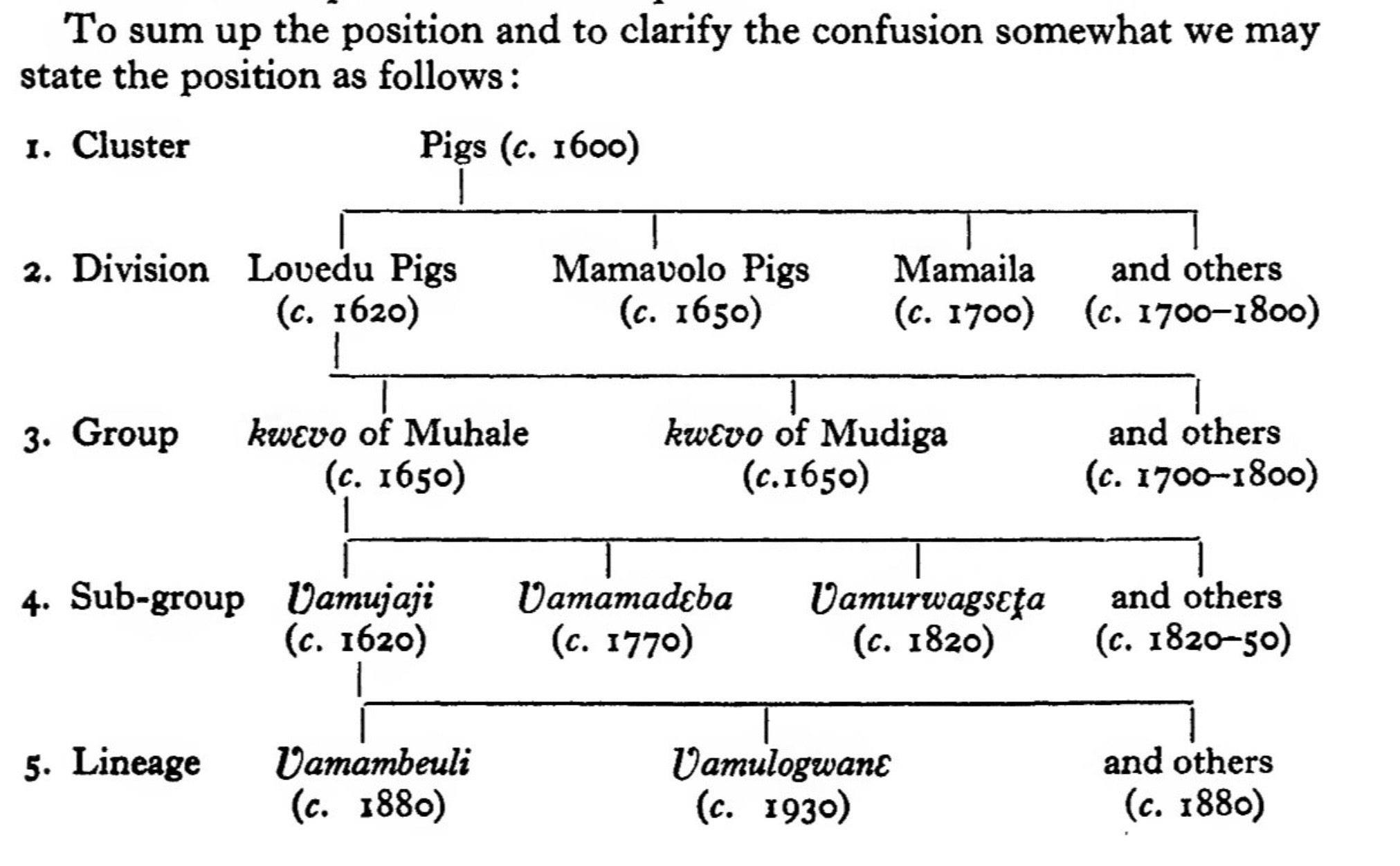
The supplied chart organises related communities through five levels. Its language belongs to an older ethnographic tradition. The word “Pigs” is reproduced only because it appears in the source; it should be understood in relation to the warthog totem, not as a description of the people.

Historical book chart classifying the warthog-totem cluster into Lobedu divisions, Muhale and Mudiga groups, sub-groups and lineages
Supplied book chart. Historical spellings are preserved in the transcription beside it.
  1. 1 · ClusterWarthog-totem clusterRendered as “Pigs” in the historical source, c. 1600.
  2. 2 · DivisionLobedu and related divisionsThe chart places “Lobedu Pigs” at approximately c. 1620.
  3. 3 · GroupModika, Mahasha and MohaleThe correct founding group consists of all three royal siblings. “Muhale” and “Mudiga” are retained only as the book’s defective spellings.
  4. 4 · Sub-groupVamujaji and related branchesThe Modjadji branch is placed within the wider royal genealogy.
  5. 5 · LineageVamambeuli, Vamulogwane and othersLater lineages emerge beneath the royal sub-groups.

Source provenance

Who informed the written record matters.

Some details in the published account may reflect a mistake made during the fieldwork process. The archive records this as a source-criticism concern—not as a proven finding—and therefore tests the book’s claims against independent manuscripts, clan praises and testimony from all three founding houses.

Rain knowledge and custodianship

The mofoko attributed to the Modika house

The Realm of a Rain Queen attributes a rain medicine, described as a mofoko, to the Modika house. This is significant: it places the house not only beside the institution of queenship as counsellor and protector, but also within the guarded knowledge system through which rain authority was sustained.

The archive treats mofoko as specialised ritual knowledge. It does not publish ingredients, restricted procedures or sacred details. Its purpose here is to preserve the historical attribution and the constitutional relationship it reveals.

Sacred sovereigntyRain QueenAuthority and national unity
Custodial knowledgeModika HouseMofoko, counsel and protection

Early districts and villages

A geography of expanding royal authority

The manuscripts and living tradition remember settlement in stages. The three founding centres were followed by royal capitals, offshoot communities and districts associated with later succession and migration.

PlaceHouse or periodHistorical significance
KhumelongMahasha / Phetole period

First recorded royal settlement; Mahasha remained here when his wife was pregnant.

Badimong, Tlatša ForestMohale

The settlement established by Mohale after the death of Kgoši Phetole and preserved in Mohale praise tradition.

TsanakoloModika

Eastern settlement on the Great Letaba River, associated with present-day Tsaneng/Tzaneen.

Lenokwe and LebyeniLater royal succession

Royal centres connected to the expanding line through Mohale, Seale and later rulers.

Sehlakong and SekgutengEarly Rain Queen period

Settlements named in accounts of the first Modjadji and the consolidation of female rule.

Thobolo, Bodupe, Mmamaila and KarengBranching communities

Places associated in the Mathekga narratives with royal relatives and communities moving from the central line.

This register is an expandable historical layer. Names, spellings, present-day locations and custodial affiliations should be verified with the relevant communities before being treated as final.

Queenship and continuity

The Modika princess beside the Rain Queen

Balobedu royal memory holds that no Rain Queen ruled without a Modika princess serving as her right-hand woman. This was not merely personal assistance. It expressed continuity between the Rain Queen’s sacred sovereignty and the founding house responsible for counsel, protection and royal order.

The throne

The Rain Queen

Sacred authority, rainmaking legitimacy and the unity of the Balobedu Nation.

The right hand

The Modika Princess

Principal female counsel, continuity of founding-house memory and support to the institution of queenship.

This constitutional tradition will be expanded as the archive records the names, praise-lines and service histories of the Modika princesses who stood beside successive Rain Queens.

A living collection

The praises are not finished.

This page begins with three foundational lines. Future entries can preserve full praise poems, audio recitations, translations, the early district register and testimony from each recognised royal house.

Return to the source archive